
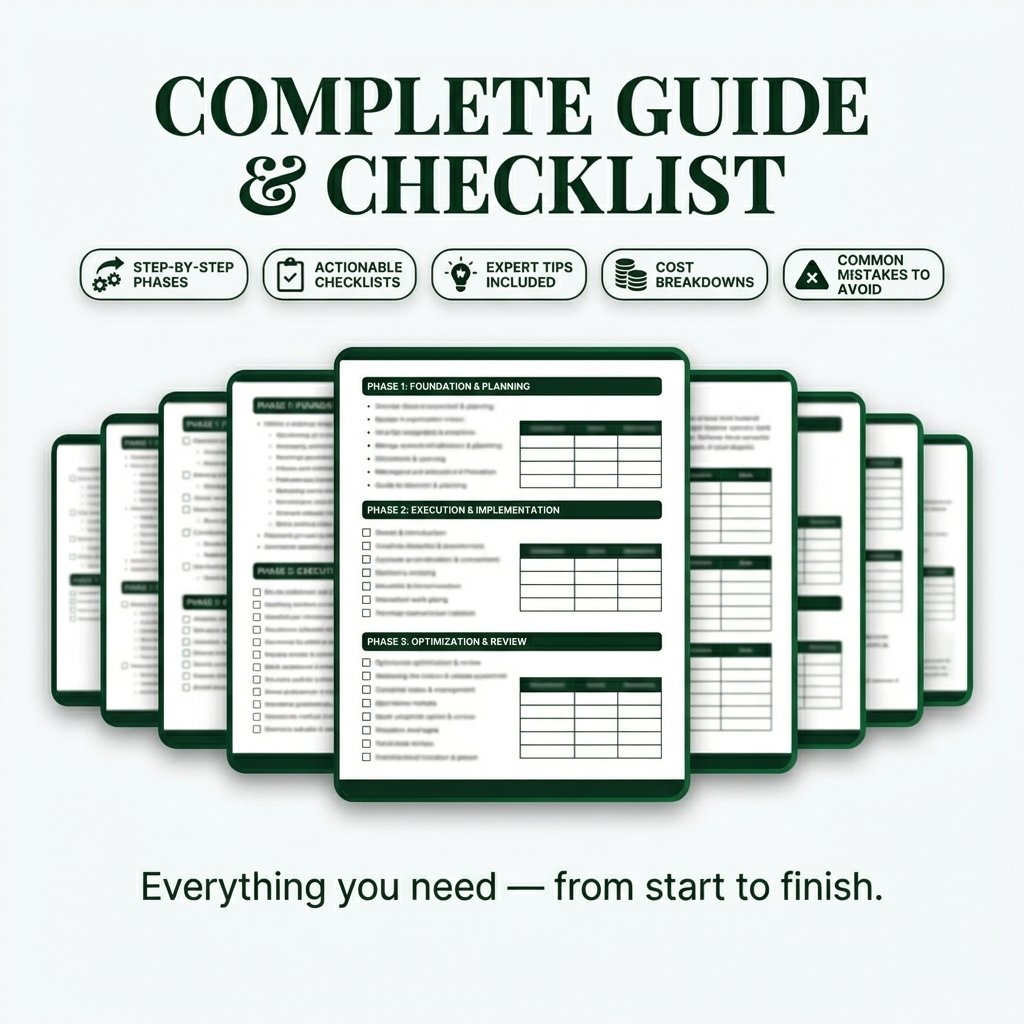
The Complete Getting Married Guide & Checklist is the only wedding planning resource that takes you all the way — from the moment you get engaged to the legal and financial steps most couples don't think about until it's too late.
This isn't a Pinterest board. It's a 12-page, step-by-step action plan organized into 8 clear phases:
Phase 1: Engagement & Big Decisions (budget, vision, wedding party)
Phase 2: Booking Venues & Key Vendors (who to hire first and why)
Phase 3: Legal Requirements (marriage license, officiant rules, what happens if you miss a step)
Phase 4: Wedding Planning Details (invitations, attire, ceremony, reception)
Phase 5: Pre-Wedding Events & Final Prep (registry, confirmations, emergency kit)
Phase 6: Wedding Day (morning-of through send-off)
Phase 7: Post-Wedding Legal & Administrative (name change, beneficiaries, insurance, estate planning)
Phase 8: Post-Wedding Wrap-Up (thank-you notes, photos, honeymoon)
You'll also get:
A real-numbers budget breakdown — national averages by category, cost per guest, and what a 150-person wedding actually costs in San Francisco vs. Milwaukee
A money-saving strategy table showing exactly how to cut costs without cutting corners (a Sunday wedding alone saves 20–40% on venue)
15 common mistakes to avoid — including the ones that can make your marriage legally invalid
Pro tips throughout — the kind of advice that usually costs $3,000 in wedding planner fees
Most wedding checklists stop at "book the florist." This one keeps going — through the name change process, updating your 401(k) beneficiaries, the 30–60 day health insurance window you can't miss, and everything else that turns a wedding into a marriage.

Having a baby is one of the most exciting — and overwhelming — things that will ever happen to you. The Having a Baby Guide & Checklist was built to hold your hand through all of it, so you can spend less time wondering what you're supposed to be doing and more time actually enjoying the journey.
Across 14 pages and 8 phases organized by trimester and milestone, it covers everything from your first prenatal appointment to your baby's third month at home:
Phase 1: First Trimester — Weeks 1–12 (confirming pregnancy, choosing your provider, prenatal vitamins, insurance review, and the lifestyle changes that matter most)
Phase 2: Second Trimester — Weeks 13–26 (anatomy scan, pediatrician research, baby registry, childbirth classes, legal and financial prep, and the childcare waitlist reality check)
Phase 3: Third Trimester — Weeks 27–40+ (nursery setup, hospital bag packing for all three of you, pre-delivery prep, and knowing exactly when to go)
Phase 4: Postpartum Recovery Supplies (vaginal birth recovery, C-section recovery, and general nursing and self-care essentials — with a tip on what the hospital actually provides so you don't over-buy)
Phase 5: Labor, Delivery & Hospital Stay (timing contractions, what to do at the hospital, the six newborn screenings your baby needs before discharge, and what you must have before leaving)
Phase 6: First Week at Home (feeding schedules, diaper tracking, sleep safety rules, and how to manage the first exhausted, beautiful week)
Phase 7: First Month & Administrative Tasks (pediatrician visits, postpartum depression warning signs, the 30-day insurance deadline most parents miss, and every legal and financial task that follows birth)
Phase 8: Settling In — Months 1–3 (developmental milestones, return-to-work planning, pumping rights, and giving yourself grace through the "fourth trimester")
You'll also get:
A first-year cost breakdown — childbirth through childcare, with low and high estimates across every major category, including how smart planning can save you $5,000–$10,000 in year one
A newborn essentials quick-reference — a must-have vs. nice-to-have table across eight categories so you build a registry that's actually useful instead of just expensive
A "when to call the doctor" checklist — 12 specific newborn warning signs with clear guidance on what warrants a call vs. a 911
10 common mistakes to avoid — including the ones that catch even prepared parents off guard
Most baby guides focus on the pregnancy. This one keeps going — through the hospital stay, the first sleepless week at home, the administrative tasks nobody warns you about, and the moment you realize you're actually doing it.

The Complete Home-Buying Guide & Checklist is the only resource that takes you through the entire purchase process — from cleaning up your credit and saving for a down payment to signing at the closing table and settling into your new home.
This isn't a mortgage company brochure. It's a 10-page, step-by-step action plan organized into 8 clear phases:
Phase 1: Financial Preparation (credit, debt, savings, and true affordability)
Phase 2: Assistance Programs & Mortgage Prep (first-time buyer programs, loan types, and every document you'll need)
Phase 3: Mortgage Pre-Approval (how to compare lenders, what pre-approval actually means, and when to lock your rate)
Phase 4: House Hunting (building your team, defining criteria, researching neighborhoods, evaluating properties)
Phase 5: Making an Offer & Negotiations (comps, contingencies, earnest money, and how to negotiate)
Phase 6: Under Contract (inspections, appraisal, title, underwriting, and what not to do while you wait)
Phase 7: Closing Day (final walkthrough, what to bring, what you're signing, and how to avoid wire fraud)
Phase 8: Post-Closing & Move-In (first week, first month, and ongoing homeownership)
You'll also get:
A complete document checklist — every financial record, tax form, and piece of paperwork your lender will ask for, organized before you need it
A full breakdown of first-time buyer programs — FHA, VA, USDA, Fannie Mae HomeReady, state HFA grants, and employer assistance programs most buyers never know to ask about
9 types of specialized inspections — from radon and mold to lead paint and foundation engineers, with guidance on when each one applies
12 common mistakes to avoid — including the ones that can kill your deal after you're already under contract
Most home-buying guides stop at "get pre-approved and find an agent." This one keeps going — through the inspection negotiation, the appraisal gap, the underwriting black hole, and the post-closing steps that protect your investment for years to come.

Selling your home is likely the largest financial transaction of your life. The Complete Home-Selling Guide & Checklist is built to help you approach it like one — with a clear strategy, a realistic timeline, and the knowledge to protect every dollar of your equity from preparation to closing day.
Spanning 13 pages and 9 phases, it covers the full arc of the selling process:
Phase 1: Strategic Planning (assessing your financial position, researching your local market, choosing your selling approach, and setting a price that attracts buyers instead of scaring them off)
Phase 2: Home Preparation & Repairs (pre-listing inspection, structural and major repairs, minor touch-ups, and a paint and refresh guide focused on what actually moves the needle)
Phase 3: Declutter, Clean & Stage (depersonalizing room by room, a complete deep-clean checklist, staging principles, and a room-by-room quick-check for every showing)
Phase 4: Curb Appeal & Exterior (landscaping, exterior maintenance, and the data on why this phase alone can add up to 7% to your sale price)
Phase 5: Marketing & Listing (professional photography, MLS strategy, showing preparation, and an 8-step pre-showing checklist to keep your home ready at all times)
Phase 6: Disclosures & Legal Requirements (what you must disclose, what happens if you don't, and every document you need to locate before going under contract)
Phase 7: Offers, Negotiation & Under Contract (how to evaluate an offer beyond price, navigating inspection findings, appraisal gaps, and keeping the deal alive)
Phase 8: Closing (pre-closing preparation, utility transitions, what to bring, and every document you'll sign to transfer ownership)
Phase 9: Post-Closing (address updates, mortgage payoff confirmation, tax filing requirements, and closing out the transaction cleanly)
You'll also get:
A typical seller costs breakdown — 12 line items from agent commissions to staging, with a bottom-line figure showing what sellers on a $400,000 home can expect to net after expenses
A capital gains tax section — the Section 121 exclusion explained in plain English, 2026 tax rates if you exceed it, and the record-keeping habits that reduce your taxable gain
A selling timeline table — from pre-listing prep through closing, with average days at each stage so you can plan your move with confidence
14 common mistakes to avoid — including the ones that cost sellers thousands in lost negotiations, legal exposure, or unnecessary price reductions
Most home-selling guides stop at "list with an agent and accept an offer." This one goes deeper — into why FSBO homes sell for 15–26% less, how to handle a low appraisal, what disclosures can expose you to a lawsuit, and why the capital gains exclusion limits set in 1997 may affect more sellers than ever in today's market.

The When a Loved One Dies Guide & Checklist is the most complete resource available for navigating one of the hardest experiences a person can face — covering not just the funeral, but every legal, financial, and emotional step that follows.
This isn't a sympathy card. It's a 15-page, compassionate step-by-step action plan organized into 8 clear phases:
Phase 1: Immediate Steps — First 24–48 Hours (what to do first, who to call, what can wait)
Phase 2: Funeral & Memorial Planning (burial vs. cremation, choosing a funeral home, planning the service)
Phase 3: Legal & Administrative Tasks (death certificates, government notifications, canceling accounts, protecting against identity theft)
Phase 4: Estate Settlement & Probate (locating documents, opening probate, what bypasses the court entirely)
Phase 5: Financial Settlement (insurance claims, survivor benefits, debts, taxes)
Phase 6: Property, Assets & Distribution (real estate, vehicles, personal belongings, closing the estate)
Phase 7: Grief, Self-Care & Healing (understanding grief, physical and emotional care, support resources)
Phase 8: Honoring & Remembering (memorials, ongoing remembrance, moving forward)
You'll also get:
A funeral and disposition cost comparison — from direct cremation ($1,000–$3,500) to traditional funeral and burial ($8,300–$12,000+), with a full breakdown of every additional cost most families don't see coming
A complete estate settlement timeline — from Day 1 through Month 12 and beyond, so you always know what comes next
A documents reference table — 14 critical documents, where to find them, and exactly what each one is used for
10 common mistakes to avoid — including the ones that can make you personally liable as executor
Most resources stop at the funeral. This one keeps going — through probate, creditor claims, the final tax return, asset distribution, and the step most people forget: updating your own estate documents once the estate is closed.

Most people spend decades building toward retirement without ever having a clear picture of what "ready" actually looks like. The Complete Retirement Planning Guide & Checklist changes that — giving you a concrete, phase-by-phase roadmap from wherever you are today to the retirement you've been working toward.
Spanning 14 pages and 9 phases organized by how far out you are, it covers every dimension of retirement — not just savings:
Phase 1: 10+ Years Out (defining your vision, assessing your financial health, maximizing contributions, and harnessing the power of compounding)
Phase 2: 5 Years Out (fine-tuning your plan, catch-up contributions, investment strategy, healthcare planning, and debt elimination)
Phase 3: 2–3 Years Out (Social Security strategy, account consolidation, tax planning, and Roth conversion windows)
Phase 4: 1 Year Out (Medicare enrollment, employer transition, insurance review, and building your cash buffer)
Phase 5: Estate Planning & Legal Documents (wills, trusts, powers of attorney, beneficiary review, and organizing everything in one place)
Phase 6: Withdrawal Strategy & Tax Optimization (account sequencing, tax bracket management, RMDs, and IRMAA avoidance)
Phase 7: Lifestyle, Housing & Purpose (where to live, how to stay engaged, and why social connection matters as much as money)
Phase 8: Final Countdown — Last 3–6 Months (financial final steps, administrative tasks, and emotional preparation)
Phase 9: First Year of Retirement (monitoring spending, adjusting withdrawals, Medicare check-ins, and finding your new rhythm)
You'll also get:
A Social Security claiming age comparison — showing dollar-for-dollar how benefits change from age 62 to 70, with break-even ages calculated so you can make the decision that's right for your situation
A Medicare Parts at a Glance table — Parts A, B, C, D, and Medigap explained side by side with 2025 premiums, deductibles, and key tradeoffs
A retirement account withdrawal order framework — which accounts to tap first, second, and last to minimize your lifetime tax burden
10 costly mistakes to avoid — including the ones that permanently reduce your income, trigger avoidable penalties, or leave your family without the legal protections they need
Most retirement guides tell you to save more and diversify. This one tells you when to claim Social Security, how to sequence your withdrawals to stay in a lower tax bracket, what to do with your employer benefits the year you leave, and why a 65-year-old couple should plan for at least one spouse to live past 90.

Divorce is one of the most legally complex, financially consequential, and emotionally exhausting things a person can go through. The Complete Divorce Guide & Checklist was built to make sure you don't navigate it blind.
Across 14 pages and 9 phases, it walks you from the first hard decisions all the way through rebuilding your finances and your life:
Phase 1: Emotional & Personal Preparation (building your support system, safety planning, setting up independent accounts before you file)
Phase 2: Legal Preparation (understanding your state's laws, hiring the right attorney, choosing the right divorce method)
Phase 3: Financial Inventory & Documentation (every account, asset, debt, and insurance policy you need to locate and document before settlement talks begin)
Phase 4: Children & Custody (custody types, parenting plans, child support, and how to tell the kids)
Phase 5: Filing & the Legal Process (petitions, temporary orders, discovery, and what happens when you can't agree)
Phase 6: Spousal Support / Alimony (the five types of alimony, what courts consider, and where negotiation has the most room)
Phase 7: Property Division (marital vs. separate property, QDROs, business valuations, and the tax traps most people miss)
Phase 8: Finalizing the Divorce (settlement agreement, trial, and executing every transfer required by the decree)
Phase 9: Post-Divorce Checklist (name change, beneficiaries, estate planning, insurance, financial reset, and recovery)
You'll also get:
A side-by-side divorce method comparison — uncontested ($3,000–$8,000) vs. contested trial ($78,000–$200,000+), with timelines, cost ranges, and who controls the outcome in each scenario
A full cost breakdown table — 11 line items from court filing fees to forensic accountants, so you know what you're walking into before you hire anyone
16 common mistakes to avoid — including the ones that can make a judge rule against you, expose you to personal liability, or cost you decades of financial damage
A critical warning on beneficiaries most people don't know — your divorce decree does not automatically remove your ex from your 401(k). Federal law may override your will. This guide tells you exactly what to do and when.
Most divorce resources tell you what forms to file. This one tells you what to do before you file, what not to do while the case is open, and what to fix the moment it's over.

Dealerships negotiate cars for a living. Most buyers do it once every several years. The Complete Car-Buying Guide & Checklist levels the playing field — giving you the research, the numbers, and the exact tactics to walk in prepared and walk out with a deal you're confident in.
Across 13 pages and 9 phases, it covers every stage from your first budget calculation to the moment you drive off the lot:
Phase 1: Budget & Financial Preparation (true cost of ownership, down payment targets, credit score, and getting pre-approved before you set foot in a dealership)
Phase 2: Research & Vehicle Selection (defining your needs, reliability ratings, safety scores, invoice price research, and what people in your area are actually paying)
Phase 3: Used Car Due Diligence (vehicle history reports, a full physical inspection checklist, and the pre-purchase inspection most buyers skip — and regret)
Phase 4: Documents & Preparation (everything to gather the night before, including what you need if you're trading in a vehicle)
Phase 5: Negotiation Tactics (15 numbered rules for the sales floor — from how to anchor on invoice price to how to handle the "let me talk to my manager" stall)
Phase 6: Hidden Fees & F&I Traps (a fee-by-fee breakdown of what's legitimate, what's negotiable, and what to refuse outright)
Phase 7: At the Dealership (test drive checklist and how to close the deal without getting maneuvered on the back end)
Phase 8: Insurance, Registration & Drive-Off (coverage decisions, title transfer, and what to verify before you accept the keys)
Phase 9: Post-Purchase (first week steps, emergency kit checklist, and ongoing maintenance habits that protect your investment)
You'll also get:
A new vs. used vs. lease comparison table — breaking down monthly cost, depreciation, equity, mileage limits, and long-term value so the right choice is obvious before you start shopping
A hidden fee decoder — showing exactly what each junk fee is called, what the dealer will tell you it's for, and precisely what to say to refuse it
A negotiation quick-reference card — eight real dealer lines with word-for-word responses, plus the golden rules in a format you can screenshot and bring with you
14 common mistakes to avoid — including the ones that quietly cost you thousands after you think the deal is done
Most car-buying guides end at "do your research and negotiate." This one shows you how — with the exact phrases, the specific numbers, and the psychological tactics dealers use so you know how to counter every move before they make it.
No results match your search. Try removing a few filters.
